
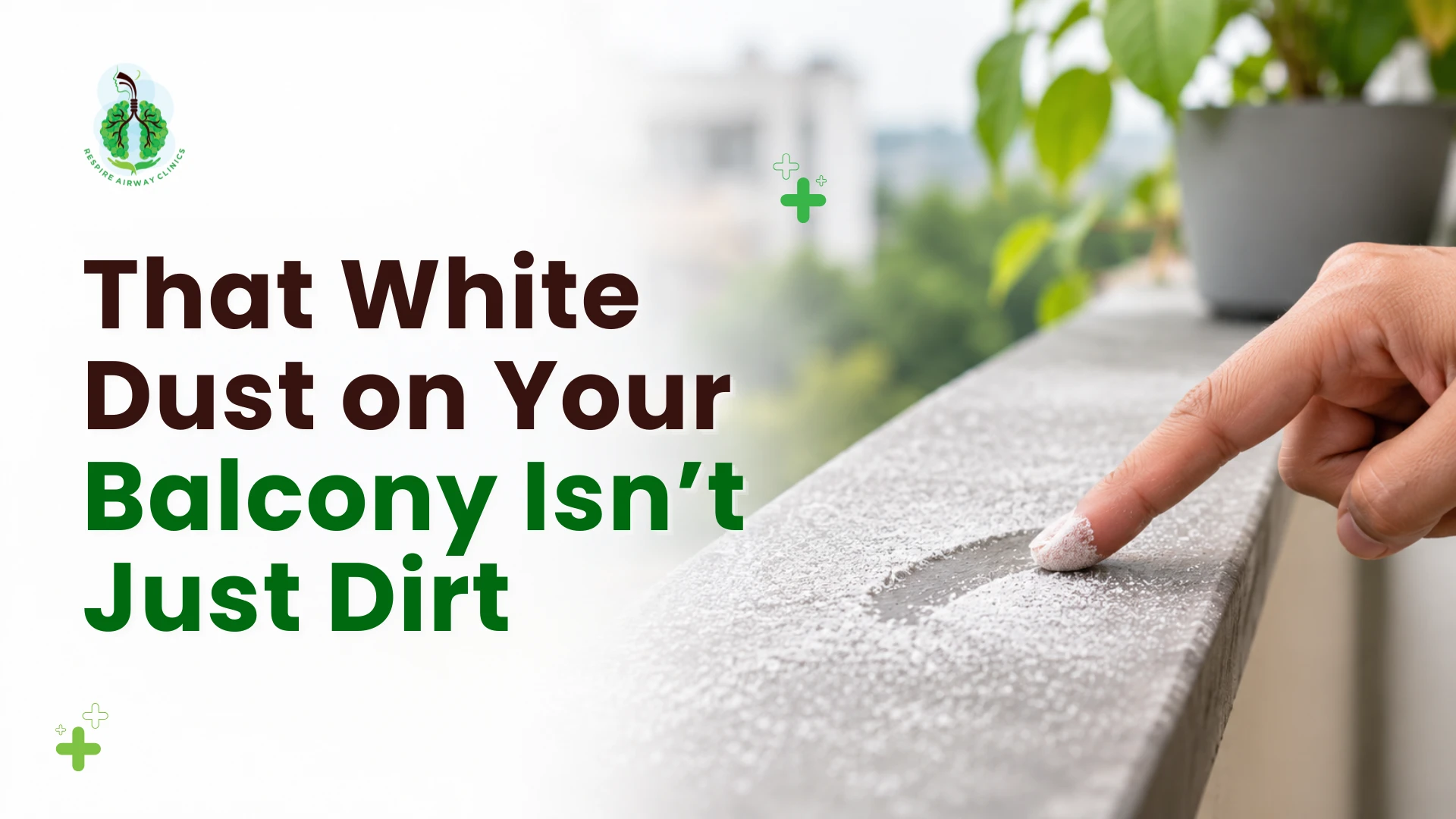
Each morning, you step onto your balcony and run a finger along the railing. A fine layer of white dust comes away on your fingertip. You notice the same powdery coating on your chairs, plant pots, and your car parked downstairs.
You wipe it away and carry on with your day. By tomorrow, it’s back.
Most of us see it as just another cleaning chore. But that film is made up of particles, and you’re breathing them in, too. At Respire Airway Clinics, we want to explain what it is and the effects of dust on lungs.
What That Film Is Actually Made Of
It’s not just one thing. It’s a combination, and in a growing city like Hyderabad, the main factors are:
- Construction and cement dust: Digging, mixing, cutting, and demolition release fine particles into the air. Research by the Council on Energy, Environment and Water (CEEW) identifies construction and demolition as major sources of urban air pollution in India.
- Road dust: Vehicles passing by keep kicking dust back into the air.
- Fine particles (PM10 and PM2.5). PM10 consists of larger dust particles that are often visible in the air. PM2.5 particles are much smaller and can travel deep into your lungs when you breathe. Pollution reports in India show that road and construction dust are the main sources of PM10, while PM2.5 mainly comes from burning fuel, wood, and garbage.
- Silica: sand, soil, and cement contain silica, and construction dust does too.
Why Hyderabad Balconies Collect So Much of It
Hyderabad’s own research points to a similar pattern. A source apportionment study presented to the Telangana State Pollution Control Board reported that road dust and vehicles are major contributors to particulate pollution in the city.
Research published in Hyderabad found that resuspended road dust made up about 30 to 45 percent of PM10, depending on the season, alongside vehicle exhaust emissions. A separate IIT Hyderabad study recorded higher PM10 near a construction site than in a residential urban area, because construction activities release fine earth and cement particles.
India’s rules do try to control this. CPCB guidelines state that sites shouldn't leave loose sand, soil, or construction waste uncovered. In practice, though, dust still travels and settles on balconies and through open windows.
The Effects of Dust on Lungs, Day After Day
To be honest about the impact. One dusty morning won’t damage your lungs. Your airways can handle a period of poor air.
The concern is repeated dust exposure, day after day, for months or years. According to India’s parliamentary records on air pollution, PM10 is associated with cardiopulmonary problems. PM2.5 may irritate the airways, cause coughing, and make asthma worse. A systematic review by the International Institute for Population Sciences found that particulate matter is a major cause of respiratory health problems in India and is linked to COPD, wheezing, and hospital visits.
In daily life, that can look like:
- A dry or scratchy throat
- A recurring cough
- A blocked or runny nose
- Frequent allergy and asthma symptoms
A note on silicosis: a lung disease involving scarring caused by silica dust, is primarily found in workers exposed to high levels over long periods, including miners and stone workers. According to the ICMR-NIOH, it is fully preventable. Balcony dust is not the same as workplace exposure, but we suggest you avoid breathing fine dust when possible.
Who Feels It Most
Everyone breathes the same air, but some people are affected quickly. India’s health ministry plan on air pollution lists people who can be affected sooner than others, pregnant women, outdoor workers, the elderly, and children under 14 as more vulnerable.
- Children: whose breathing rate is faster for their size
- Older adults: whose lungs may already be weakened
- People with asthma, COPD or allergies: whose airways are already prone to sensitivity
- People living on the ground or lower floors: in apartments next to a construction site, where dust is closest
When It’s More Than Dust
It’s easy to blame dust for everything. These signs call for a closer look:
- A cough that continues for weeks
- Shortness of breath when climbing stairs or doing everyday tasks
- Wheezing, especially at night or in the early morning
- Frequent “colds” that don’t fully go away
- Allergies that keep getting worse
There can be many causes, and dust may be just one.
What You Can Do at Home
You can’t remove the tiniest dust, but we can suggest ways to breathe in less of it.
- Keep windows and balcony doors shut on dusty days, especially when there is construction nearby.
- Wet-wipe, don’t dry-sweep. Dry sweeping lifts dust back into the air. A damp cloth absorbs it.
- Use an air purifier with a proper filter in the rooms where you spend the most time.
- Wear a well-fitted mask while riding or cleaning. A properly sealed N95 filters fine particles. A normal cloth mask wouldn’t do much.
- Keep allergies and asthma under control. Take your medicines as prescribed and keep your follow-ups. If your symptoms get worse, don’t change your treatment on your own. Talk to us and book a tele-consultation with Respire Airway Clinics.
These steps may lower your exposure. They do not treat symptoms or replace a medical checkup.
Get a Stubborn Cough Checked
The dust on your balcony is easy to ignore. The effects of dust on lungs build up quietly, which is why a cough or breathlessness that won’t go away shouldn’t be brushed aside.
At Respire Airway Clinics, our pulmonology, ENT, and sleep specialists work together as one team. A cough can come from the lungs, the nose, allergies, or even disturbed sleep, and we look at all of it in a single assessment. You can visit us at Basheer Bagh, Jubilee Hills, or Kondapur.
Note: Emergency symptoms: Seek urgent medical care if you have severe breathlessness, trouble speaking in full sentences, blue or grey lips or fingertips, confusion, or no improvement after using a prescribed quick-relief inhaler.
References
- https://telanganatoday.com/road-dust-found-to-be-main-contributor-to-particulate-matter-pollution-in-hyderabad
- https://urbanemissions.info/wp-content/uploads/docs/2014-06-AQAH-Hyderabad-Air-Emissions-Health.pdf
- https://raiithold.iith.ac.in/5635/
- https://www.ceew.in/node/4510
- https://www.cseindia.org/content/downloadreports/13196
- https://www.greentribunal.gov.in/sites/default/files/news_updates/Reply%20on%20behalf%20of%20R%2010%20in%20OA%20No%20102%20of%202026%20Deepak%20Agarwal%20Vs%20UOI%20and%20Ors.pdf
- https://www.pressreader.com/india/hindustan-times-st-noida/20240330/281694029787593
- https://eparlib.nic.in/bitstream/123456789/957022/1/AU128.pdf
- https://www.iipsindia.ac.in/sites/default/files/Short%20and%20long%20term%20exposure%20to%20ambient%20air%20pollution%20and%20impact%20on%20health%20in%20India%20a%20systematic%20review.pdf
- https://ncdc.mohfw.gov.in/uploads/pdf/air7.pdf
- https://link.springer.com/content/pdf/10.1186/s12995-023-00379-1.pdf
- https://www.weforum.org/stories/health-and-healthcare-systems/what-is-the-best-mask-for-covid-19-a-mechanical-engineer-explains-the-science-after-2-years-of-testing-masks-in-his-lab/