
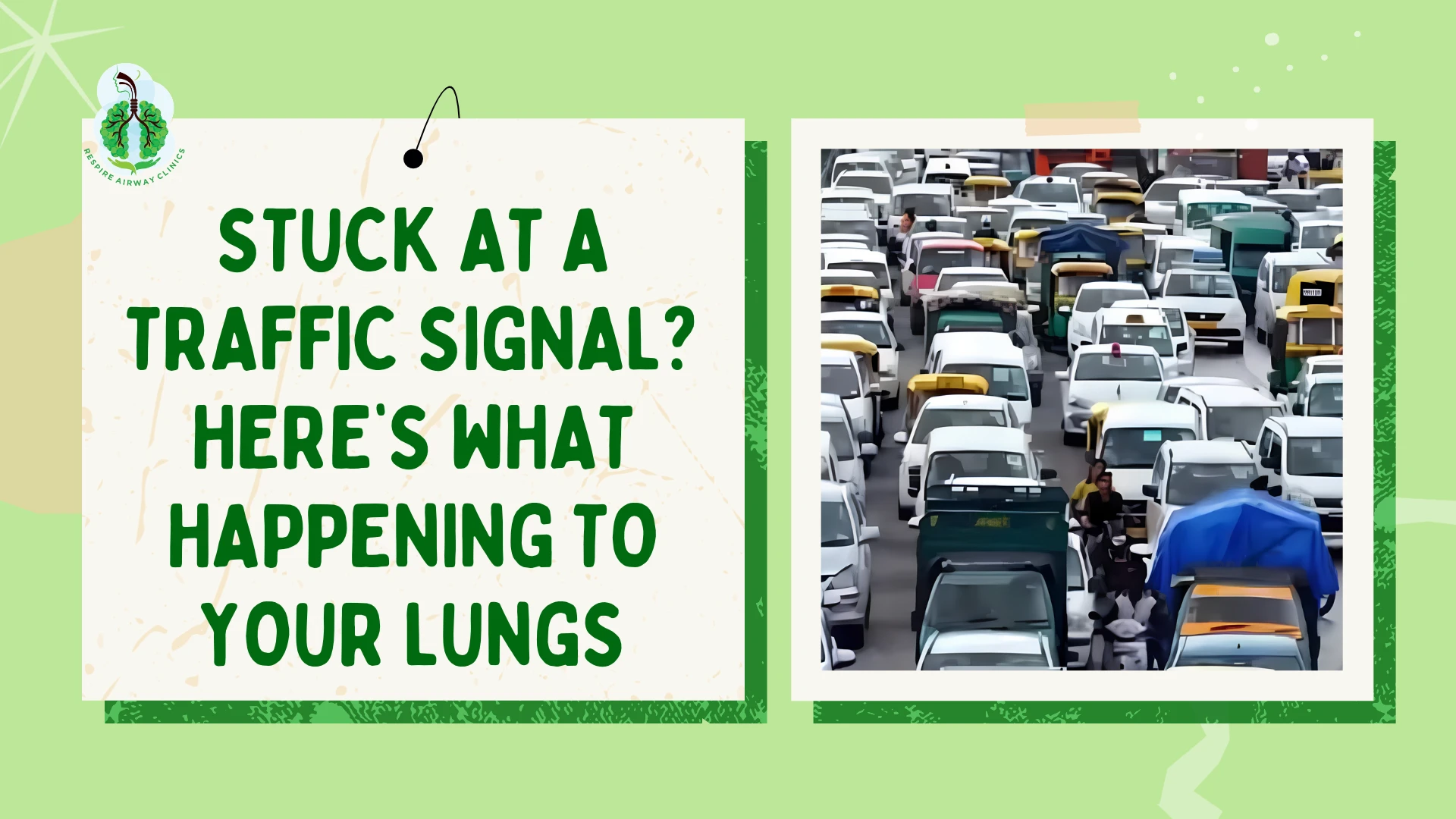
You’re waiting at a red light. The bus is on your left, an auto on your right, and a line of cars ahead. All the engines are running. Most of us check our phones or watch the countdown while we wait. Not many of us think about the air we’re breathing.
Have you noticed the air feels different when you’re waiting behind a bus or auto at a traffic signal? Traffic junctions expose you to a concentrated blend of vehicle emissions. At Respire Airway Clinics, we want to help you understand what’s in that air and explain the effects of air pollution on lungs.
Why Traffic Signals Can Be Dirtier Than Open Roads
On an open road, vehicles keep moving, allowing exhaust to disperse behind them. At a signal, that changes.
Engines keep running: Idling vehicles still release exhaust.
Stop-and-go driving: Whenever traffic speeds up and slows down, emissions change and often increase.
Vehicles packed together: At busy Hyderabad intersections, cars, buses, two-wheelers, and autos line up just a few feet apart. Riders are often close to vehicle exhausts.
Little air movement: Pollutants may take longer to disperse from a busy intersection, depending on the weather and nearby surroundings.
What’s Actually Entering Your Lungs at a Traffic Signal?
You can follow this without a chemistry degree, keep four main things in mind.
PM2.5: fine particles that can travel deep into your lung:. These tiny particles can pass through the upper airways and enter deep into the respiratory system, where they may cause inflammation.
Ultrafine particles: even smaller than PM2.5: These particles are linked to vehicle emissions and can reach deep into the respiratory tract.
Nitrogen dioxide (NO₂): This gas is emitted by vehicle engines. It may irritate the airways and make breathing conditions worse.
Benzene: A chemical you should avoid breathing regularly. It occurs in vehicle emissions and is a known human carcinogen. To be clear, waiting briefly at a traffic signal will not cause cancer. The concern is repeated exposure over a long period.
All these pollutants don’t behave the same way, but they share one thing, your lungs are exposed to them every time you breathe in that air.
One Red Light Is One Thing. What About Every Day?
Let’s be straight about this. Waiting at one traffic signal won’t damage your lungs. Your airways can handle an occasional bad stretch of air.
The situation is different if you drive through heavy traffic every day. Then it isn’t just one red light, but ongoing exposure that repeats for months and years. Over time, breathing in particulate matter and traffic gases for a long period can cause ongoing airway irritation and inflammation. This may worsen symptoms and lead to more flare-ups in people with lung conditions. Do not wait until it gets worse; book an online consultation with us today.
The concern isn’t just those 10 minutes. It’s how often those 10 minutes happen.
Who Takes the Biggest Hit While Waiting at Signals?
Everyone at the junction breathes the same air, but some people are exposed to more pollution or are more sensitive to its effects.
Two-wheeler riders: Without a cabin around you. Whatever the traffic releases, you breathe.
Auto passengers: Open sides provide almost no protection from the exhaust released around.
Children:: Their lungs are still developing, and they breathe faster relative to their body size.
People with asthma or COPD: For people with sensitive airways, pollutants can increase coughing, wheezing, and breathlessness.
Daily commuters: The more time you spend on traffic-clogged roads, the more often you are exposed to this air.
When Should You Stop Blaming the Traffic and See a Doctor?
There is no need to panic. But some symptoms need immediate attention:
- A cough that returns often or does not go away
- Wheezing after traveling through high-traffic areas
- Chest discomfort or tightness during breathing
- Shortness of breath during everyday activities
- Asthma or COPD symptoms getting worse
These can have many causes, and traffic pollution may be only one of them. That’s exactly why guessing doesn’t help. If your symptoms are persistent or getting worse, contact our clinic today. Don’t write it off as dust or seasonal allergies.
Can You Protect Your Lungs While Waiting at a Red Light?
One cannot avoid traffic during the commute, but a few habits reduce how much exhaust you take in and reduce the effects of air pollution on your lungs
- Keep your car windows closed while waiting in heavy traffic.
- Use recirculation mode; it cuts down the outside air entering the cabin, though it doesn’t offer complete protection.
- Wear a well-fitted N95 mask on a two-wheeler, as it filters fine particles. It does not stop gases like NO₂ and benzene.
- Leave a gap behind buses and trucks; don’t sit right behind an exhaust pipe if you can avoid it.
- Choose a less congested route when you have the option; less time in dense traffic means less exposure.
- Service your car’s cabin air filter as the manufacturer recommends.
These steps can help you manage exposure. They are not a treatment and do not replace having your symptoms checked.
Your Nose, Lungs and Sleep Are More Connected Than You Think
An occasional red light is nothing to worry about. Repeated exposure to traffic pollution is worth taking seriously.
At Respire Airway Clinics, our Pulmonologist, ENT and Senior Respiratory Physician work together to look after your airway health, from your nose to your lungs to your sleep. One team, one assessment, one clear answer about what’s going on.
If breathing has become harder than it should be, book a consultation with Respire Airway Clinics today.
References
- https://www.who.int/news-room/fact-sheets/detail/ambient-(outdoor)-air-quality-and-health
- https://www.epa.gov/pm-pollution/particulate-matter-pm-basics
- https://www.epa.gov/no2-pollution/basic-information-about-no2
- https://www.who.int/publications/i/item/WHO-CED-PHE-EPE-19.4.2