
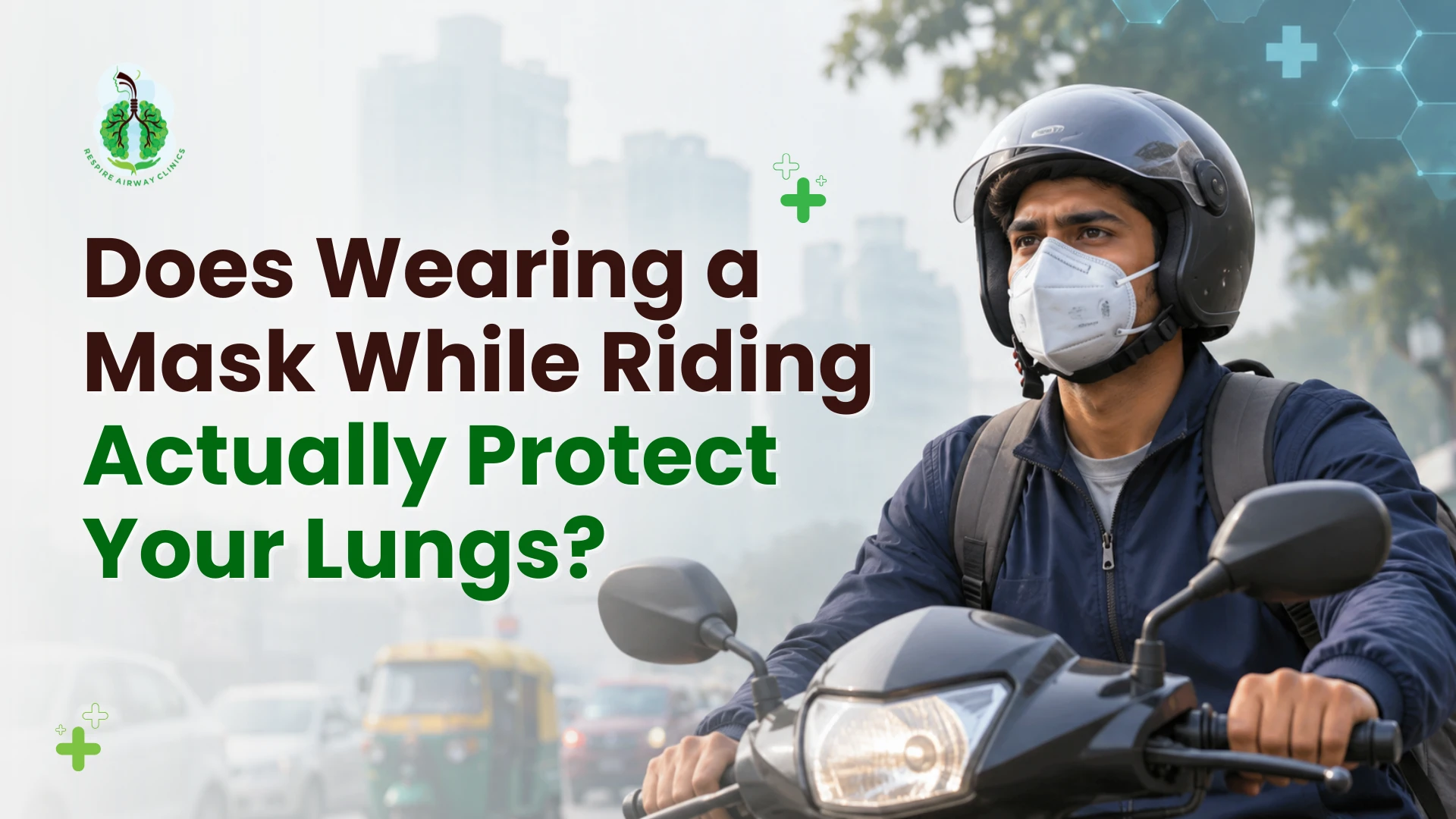
The rough cough after every ride is real. When you return from riding through traffic, your throat may feel scratchy and your chest a little tight. Maybe you also cough for a while before it settles.
It happens to many riders, and it’s easy to blame dust in the air. But there may be a clearer reason: what you breathe in while riding through the city.
Many riders wear a mask to deal with this. The real question is whether a mask can protect lungs, or whether it only feels like it does. At Respire Airway Clinics, we get this question often. Here's the honest answer.
Why Riders Breathe the Worst Air on the Road
If you're in a car, you have a cabin around you. On a two-wheeler, you don't.
- Vehicle tailpipes: Release exhaust at about face height. Harmful fumes and smoke from cars, auto-rickshaws, buses, and trucks are close to your breathing space, particularly at signals and when traffic moves slowly.
- Nothing blocks the air: With no window, door, or filter between you and the vehicle in front, you breathe in the same air.
- You breathe deeper: Riding takes effort, which increases your breathing, and you inhale more of the surrounding air.
According to research cited by The Conversation, cyclists and pedestrians inhale more pollutants than drivers, as physical activity increases their breathing rate. The same applies to bike riders. Learn more about traffic pollution and lung health.
What’s Actually Hitting Your Lungs
Traffic pollution includes different substances. One of them is PM2.5. They are extremely small particles released by vehicle exhaust. They’re tiny enough to penetrate deep into the lungs and cause inflammation.
Read more about other particles here: Traffic Signal Effects of Air Pollution on Lungs.
Two of these substances are particles, while two are gases. That difference matters when we talk about masks.
Yes, a Mask Can Protect Lungs, but Only the Right Kind
Not every mask works the same way. Here’s how they compare.
- Cloth masks: they are made from woven or knitted fabrics. They provide basic protection by trapping some respiratory droplets and particles. The effectiveness varies depending on the fabric, number of layers, and fit.
- Surgical masks: they are loose-fitting, disposable masks designed to reduce the spread of respiratory droplets and protect against splashes. They offer better filtration than some cloth masks but do not seal tightly around the face.
- N95-type respirators: they are designed to filter at least 95% of airborne particles when properly fitted. They provide stronger protection against fine particles and aerosols, because they combine high-efficiency filtration with a close facial seal.
What a Mask Won’t Fix
A mask can reduce some of what reaches your lungs, but it cannot make traffic air clean. Let’s understand the respiratory problems caused by air pollution.
Indian research studies make this especially relevant for two-wheeler riders. A Delhi study of commuters found that exposure to particles differed substantially by transport mode, route and time of day, while a separate Delhi exposure study found that motorised two-wheeler riders had on-road PM2.5 exposure about 30% higher than ambient levels. Of course, Delhi pollution is worse than Hyderabad but the core of it is the same with any polluted area.
A Chennai study of real-world two-wheeler riding found that personal exposure to PM2.5 and smaller particles was highest during idling and when riding behind heavy-duty vehicles. That’s more important at signals, in slow-moving traffic, and when following buses, trucks or autos closely.
But no ordinary mask solves the whole problem. N95-type respirators are designed to filter particles; they do not reliably remove gases or vapours such as nitrogen dioxide. Indian reporting notes that N95s filter particles, not gases, and that real-world protection depends on genuine certification, correct wear and a proper seal.
Why Fit and Seal Matter
A high-filtration mask only works if polluted air cannot leak around it. Gaps at the nose, cheeks or chin allow unfiltered air to bypass the filter, and facial hair along the sealing area can interfere with the seal.
Choose a certified particulate respirator, such as a genuine N95 or FFP2-type mask. Prefer a design with two head straps where possible; it is more likely to stay secure and seal well than an ear-loop style.
Cover both nose and mouth, mould the nose clip, and check for air leaking around the edges before riding.
Do not pull the mask below the nose or remove it repeatedly during the ride.
Remember that a mask reduces particle exposure; it is not a substitute for avoiding close, prolonged exposure to exhaust.
When Your Cough Is Telling You Something
A brief throat irritation after a dusty, high-traffic ride can happen. But a cough that keeps returning, disturbs sleep, or comes with wheeze deserves attention.
See a doctor if you have persistent frequent coughing or wheezing that lasts more than a few days, especially if it is linked to riding, exercise, cold air, dust, or pollution exposure.
Asthma may cause wheezing, coughing, chest tightness, and shortness of breath. These symptoms can worsen at night or in the early morning.
Get urgent help if breathing becomes severe: trouble walking or talking, gasping, blue or grey lips or fingernails, confusion, or no improvement after using a prescribed quick-relief inhaler.
Do not dismiss a cough that repeats after every ride. Your lungs may be telling you that the airway is irritated, or that asthma or allergies need proper treatment.
Beyond Masks: Smarter Ways to Ride
A mask is one layer of protection, not the whole plan. The most effective way to reduce what reaches your lungs is to spend less time close to exhaust and avoid the highest-pollution riding conditions.
Indian studies support this. In Delhi, commuter exposure varied with transport mode, route and time of day; in Chennai, two-wheeler riders had the highest personal PM2.5 exposure while idling and riding behind heavy-duty vehicles.
Before you ride:
- Check the local air-quality forecast, especially during high-pollution periods.
- If air quality is poor, consider postponing non-essential rides or choosing a shorter route.
- Avoid riding during peak-traffic hours when you can; reduced travel during rush hours is a recognised exposure-reduction strategy.
- If you have asthma or allergies, carry your prescribed reliever inhaler if your clinician has advised it, and follow your personal action plan.
On the road:
- Do not sit directly behind an idling bus, truck, auto-rickshaw or car at a signal.
- Leave a little more space from the vehicle ahead when traffic is moving slowly.
- Choose quieter side roads where practical, rather than riding continuously along a busy main road.
- Avoid unnecessary hard acceleration and long periods in dense, slow-moving traffic.
- If you feel unusually breathless, wheezy, or chest-tight, stop safely and rest rather than pushing through the ride.
After the ride:
- Wash your face and hands, and rinse your mouth or have water if your throat feels irritated.
- If you use a reusable respirator, follow the manufacturer’s cleaning and replacement instructions.
- Do not ignore a cough that keeps returning after rides; it may be a sign that your airways need assessment.
When to See Us
A cough after a dusty ride can be normal. But if it keeps coming back, it is worth listening to. See a doctor if your cough lasts more than a few weeks, keeps returning after rides, disturbs your sleep, or comes with wheeze, chest tightness, breathlessness, or frequent allergies. These can be signs of irritated airways, allergic rhinitis, asthma, or another breathing problem that needs proper assessment.
At Respire Airway Clinics, we look at the nose, lungs, allergies and sleep together. A stubborn rider’s cough may have more than one cause, and treating the whole airway can help you breathe more comfortably on the road and off it.
If your cough is lasting, recurring, or affecting your breathing, book a consultation with Respire Airway Clinics.
Note: Emergency symptoms Seek urgent medical care if you have severe breathlessness, trouble speaking in full sentences, blue or grey lips or fingertips, confusion, or no improvement after using a prescribed quick-relief inhaler.
References
- https://theconversation.com/can-pollution-face-masks-really-protect-us-from-exposure-to-toxic-particles-131723
- https://pubmed.ncbi.nlm.nih.gov/26439646/
- https://pubmed.ncbi.nlm.nih.gov/26439646/
- https://meetingorganizer.copernicus.org/EGU25/EGU25-2082.html
- https://theprint.in/theprint-essential/n95-kn95-or-cloth-mask-which-offers-protection-against-delhis-pollution/3094298/
- https://www.cdc.gov/niosh/ppe/respirators/ffr.html
- https://www.cdc.gov/niosh/docs/2018-130/pdfs/2018-130.pdf
- https://www.cdc.gov/niosh/bulletin/2017/no-shave.html
- https://www.osha.gov/shms/chapter-18
- https://www.osha.gov/video/respiratory-protection/resp-types/transcript
- https://www.epa.gov/wildfires/protect-yourself-wildfire-smoke-and-ash
- https://theprint.in/theprint-essential/n95-kn95-or-cloth-mask-which-offers-protection-against-delhis-pollution/3094298/
- https://howtosurvive.in/n95-mask-air-pollution-aqi-levels-what-to-do-india-november-2026/
- https://www.cdc.gov/asthma/about/index.html
- https://medlineplus.gov/ency/patientinstructions/000062.htm
- https://www.mayoclinic.org/diseases-conditions/asthma/symptoms-causes/syc-20369653
- https://www.who.int/tools/compendium-on-health-and-environment/air-pollution-and-health
- https://www.who.int/teams/environment-climate-change-and-health/air-quality-energy-and-health/health-impacts/exposure-air-pollution
- https://iris.who.int/server/api/core/bitstreams/3a7708be-3c8b-4f6a-a351-08a814e76492/content
- https://pubmed.ncbi.nlm.nih.gov/26439646/
- https://library.iitd.ac.in/research/publications/W1764802427/
- http://www.urbanemissions.info/wp-content/uploads/docs/2015-12-AE-Delhi-On-Road-Exposures.pdf
- https://pmc.ncbi.nlm.nih.gov/articles/PMC8086121/
- https://meetingorganizer.copernicus.org/EGU25-2082.html
- https://ww2.arb.ca.gov/our-work/programs/people-risk
- https://oehha.ca.gov/air/air-pollution-nearby-traffic-and-childrens-health-information-parents
- https://www.epa.gov/wildfire-smoke-course/strategies-reduce-exposure-outdoors
- https://www.epa.gov/system/files/documents/2026-06/reduce-smoke-exposure-factsheet.pdf
- https://www.who.int/tools/compendium-on-health-and-environment/air-pollution-and-health
- https://www.who.int/teams/environment-climate-change-and-health/air-quality-energy-and-health/health-impacts/exposure-air-pollution